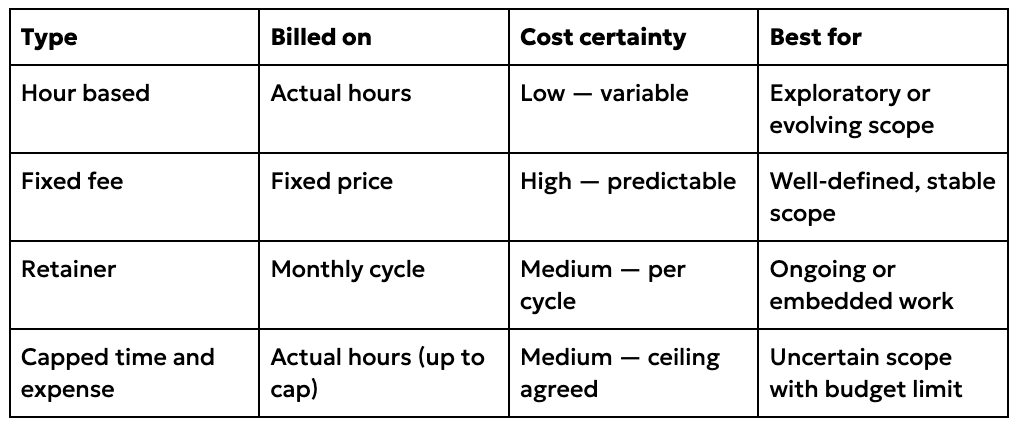
Choosing a proposal type
Rofinery proposal types
Rofinery supports four proposal types. Choosing the right one affects how the project is billed, what information is shown when sharing the proposal, and how you can view the progress of it once it is approved.
There are common points across all proposals - you start by adding deliverables (either manually or from template) and underneath these you add line items. Each line item will be what you track time against. When a proposal is approved the deliverables are converted into tasks and line items into subtasks.
For each line item, you allocate a resource and quantity of hours. You have the option to fix a fee for each line item to allow you to increase how much you’re charging, but without increasing the number of hours. You can also add expenses to line items.
Every proposal can have assumptions and exclusions added, as well as terms and conditions. There you can cover specific points such as how changes in scope are covered or any questions you may often get once a proposal has been approved, but should really be addressed earlier on.
Just to note - if you select one proposal type but then realise halfway through building it that you need it ot be different, you can simply change it.
Hour based
What it is:
Focus on delivering against hours and expenses.
When to use it
- You have a one-off project
- When the nature of the project requires that the fee charged is reconcilable to hours worked
- Client is paying on an hourly basis rather than a fixed fee, e.g. consulting
- A breakdown of hours or costs of line items may be required to justify the payment
- To cover out-of-scope work, where a separate scope has not been created
What to include in the proposal
- The correct staffing mix (resource) required - so you are accounting for the different people working on different tasks
- A realistic number of hours for each resource to deliver the work - you can fix the fee for individual line items if you want
- A justifiable contingency if there is uncertainty about the hours
- Any third-party pass-through costs
- Assumptions and exclusions around deliverables
- Terms and conditions governing the project
What the client sees in the proposal
You can show as much detail as you like in the pricing breakdown display options.
- For example, you can show the full breakdown of labour fees (but it won’t show number of hours), expenses and descriptions for each individual line item that sits under a deliverable as well as the overview of a deliverable
- You can also hide some detail - so you can choose to show just the total cost for line items, or perhaps no breakdown at all of line item costs, just giving a total for the deliverable.
Fixed fee
What it is
A single agreed price for a defined scope.
When to use it
- The scope is well-defined and unlikely to change
- The client needs cost certainty for budget approval or board sign-off
- Competitive tender situations where a fixed price is required
- Value pricing is intended
What to include in the proposal
- Tight, specific scope - what is included and what is not and how many hours are needed (being realistic, not overly optimistic)
- A clear change control process (what happens if scope changes i.e. that would be covered under a new proposal)
- Assumptions and exclusions around deliverables
- Terms and conditions governing the project
What the client sees in the proposal
\
- The client will only see the total fixed fee at the bottom of the proposal if a total fixed fee is applied. All of the content of line items and deliverables can still be fully visible
- You can also choose to hide the content of the line items in the pricing breakdown display options.
Retainer
What it is
A recurring monthly engagement, typically covering an agreed amount of work or availability each cycle. Can be rolling or for a set period of time.
When to use it
- Repeat work where you have strong confidence in your monthly estimates
- Monthly deliverables are identical, clear, and defined
- Clients who need monthly support from your team without scoping individual projects each time
- Long-term strategic partnerships or embedded team arrangements
- Situations where consistent capacity is more valuable than per-project pricing
What to include in the proposal
- What is included in the monthly deliverables
- Review cadence - when do we assess the arrangement?
- Notice period and exit terms
- A level of granularity with line items that works for you i.e. you can have more general line items if the specific activities on a monthly basis haven’t been confirmed and you want to capture those in task checklists you can create each month instead
- Monthly fees
- A justifiable contingency if there is uncertainty about the hours
- Any third-party pass-through costs
- Assumptions and exclusions around deliverables
- Terms and conditions governing the project
What the client sees in the proposal
- The client will see the total fee for the retainer at the bottom of the proposal. All of the content of line items and deliverables can still be fully visible if you don’t set a fixed figure per month
- You can also choose to hide the content of the line items in the pricing breakdown display options
- If it is a rolling retainer, they will only see the total for each month at the bottom of the proposal - if you set a fixed period, they will see the total per month for that period
Capped time and expense
What it is
Time and expense but with a maximum cap the project cannot exceed. The client gets transparency on spend and a ceiling for cost certainty.
When to use it
- The scope has some uncertainty, but the client needs a cost ceiling
- Projects where you want to bill transparently but protect the client from open-ended risk
- Situations where you aren’t sure if you want to go with a fixed fee or hour based at the start
What to include in the proposal
- The correct staffing mix (resource) required
- Estimated number of hours for each resource and their hourly rates
- Known deliverables
- A justifiable contingency if there is uncertainty about the hours
- Capped fee amount
- Any third-party pass-through costs
- Assumptions and exclusions around deliverables
- Terms and conditions governing the project
What the client sees in the proposal
As with the hour-based proposal, you can show as much detail as you like in the pricing breakdown display options.
- For example, you can show the full breakdown of labour costs (but it won’t show number of hours), expenses and descriptions for each individual line item that sits under a deliverable as well as the overview of a deliverable.
- You can also hide some detail - so you can choose to show just the total cost for line items, or perhaps no breakdown at all of line item costs, just giving a total for the deliverable.
- However - if you set a fixed fee override for the proposal, then this will remove the breakdowns for line items and deliverables, and it will show just the total for the proposal at the bottom
Quick reference: